Week Fifteen
Theseus (/ˈθiːsiːəs/; Ancient Greek: Θησεύς [tʰɛːsěu̯s]) was the mythical king of Athens and was the son of Aethra by two fathers:Aegeus and Poseidon.
Theseus was a founder-hero, like Perseus, Cadmus, or Heracles (Hercules), all of whom battled and overcame foes that were identified with an archaic religious and social order. As Heracles was the Dorian hero, Theseus was a founding hero, considered by Athenians as their own great reformer: his name comes from the same root as θεσμός ("thesmos"), Greek for "The Gathering". The myths surrounding Theseus—his journeys, exploits, and family—have provided material for fiction throughout the ages.
Theseus was responsible for the synoikismos ("dwelling together")—the political unification of Attica under Athens, represented emblematically in his journey of labours, subduing ogres and monstrous beasts. Because he was the unifying king, Theseus built and occupied a palace on the fortress of the Acropolis that may have been similar to the palace that was excavated in Mycenae. Pausaniasreports that after the synoikismos, Theseus established a cult of Aphrodite Pandemos ("Aphrodite of all the People") and Peitho on the southern slope of the Acropolis.

Hercules is the Roman name for the Greek divine hero Heracles, who was the son of Zeus (Roman equivalent Jupiter) and the mortal Alcmene. In classical mythology, Hercules is famous for his strength and for his numerous far-ranging adventures.
The Romans adapted the Greek hero's iconography and myths for their literature and art under the name Hercules. In later Western art and literature and in popular culture, Hercules is more commonly used than Heracles as the name of the hero. Hercules was a multifaceted figure with contradictory characteristics, which enabled later artists and writers to pick and choose how to represent him. This article provides an introduction to representations of Hercules in the later tradition.
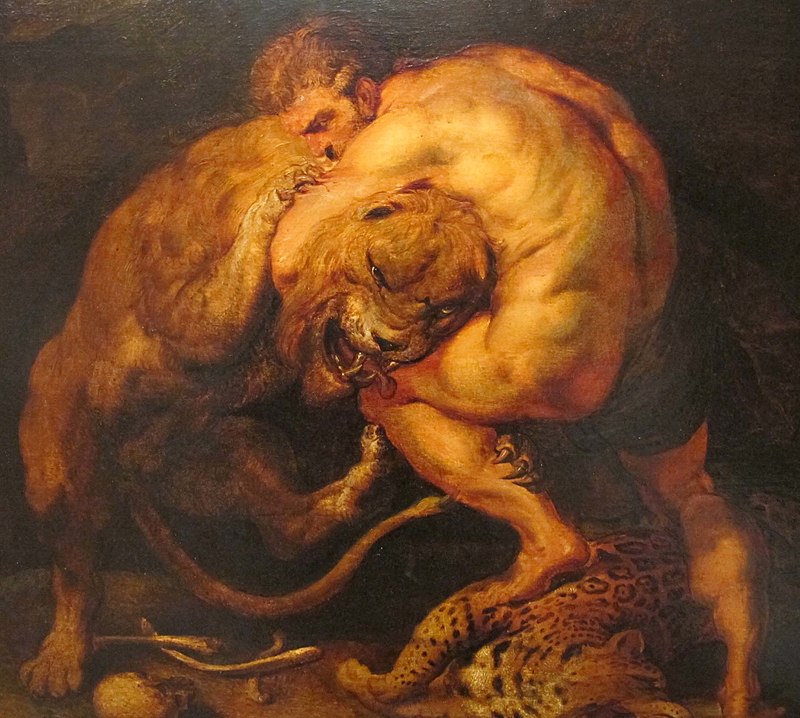
A demigod or demi-god is a divine or supernatural being in classical mythology. The term has been used in various ways at different times and can refer to a figure who has attained divine status after death, a minor deity, or a mortal who is the offspring of a god and a human being.
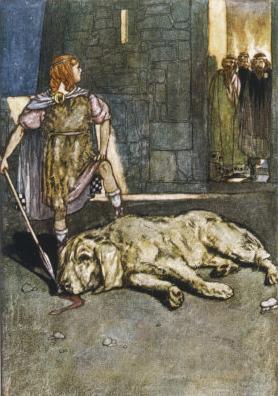

The twelve labours of Heracles or Hercules (Greek: οἱ Ἡρακλέους ἆθλοι, hoi Hērakleous athloi) are a series of episodes concerning a penance carried out by Heracles, the greatest of the Greek heroes, whose name was later Romanised as Hercules. They were accomplished over 12 years at the service of KingEurystheus. The episodes were later connected by a continuous narrative. The establishment of a fixed cycle of twelve labours was attributed by the Greeks to an epic poem, now lost, written by Peisander, dated about 600 BC. After Hercules killed his wife and children, he went to the oracle a Delphi. He prayed to the god Apollo for guidance. Hercules was told to serve the king of Mycenae, Eurystheus, for 12 years. During these 12 years, Hercules is sent to perform twelve difficult feats, called labours.

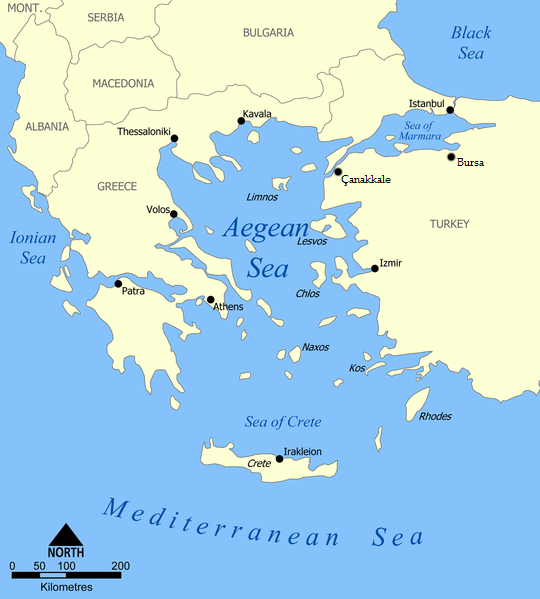
The Aegean Sea is an elongated embayment of the Mediterranean Sea located between the Greek and Anatolian peninsulas, i.e., between the mainlands of Greece and Turkey. In the north, it is connected to the Marmara Sea and Black Sea by the Dardanelles and Bosporus. The Aegean Islands are within the sea and some bound it on its southern periphery, including Crete and Rhodes.
The sea was traditionally known as Archipelago (in Greek, Αρχιπέλαγος, meaning "chief sea"), but in English this word's meaning has changed to refer to the Aegean Islands and, generally, to any island group.
In Greek mythology, Aegeus (/ˈɛdʒˌjuːs/; Ancient Greek: Αἰγεύς) or Aegeas (/ˈiːdʒiəs/; Αιγέας), was an archaic figure in thefounding myth of Athens. The "goat-man" who gave his name to the Aegean Sea was, next to Poseidon, the father of Theseus, the founder of Athenian institutions and one of the kings of Athens.

In Greek mythology, Eros (/ˈɪərɒs/ or US /ˈɛrɒs/, /ˈɛroʊs/; Greek: Ἔρως, "Desire") was the Greek god of love. His Romancounterpart was Cupid ("desire"). Some myths make him a primordial god, while in other myths, he is the son of Aphrodite. He was one of the winged love gods, Erotes.


love potion-

A story within a story is a literary device in which one character within a narrative narrates.[1] Mise en abyme is the French term for a similar literary device (also referring to the practice in heraldry of placing the image of a small shield on a larger shield). A story within a story can be used in all types of narration: novels, short stories, plays, television programs, films, poems, songs, and philosophical essays.
Titania is a character in William Shakespeare's play A Midsummer Night's Dream. In the play, she is the queen of the fairies. Due to Shakespeare's influence, later fiction has often used the name "Titania" for fairy queen characters.
In traditional folklore, the fairy queen has no name. Shakespeare took the name "Titania" from Ovid'sMetamorphoses, where it is an appellation given to the daughters of Titans.
Shakespeare's Titania is a very proud creature and as much of a force to contend with as her husband Oberon. She and Oberon are engaged in a marital quarrel over which of them should have the keeping of an Indian changeling boy. This quarrel is the engine that drives the mix ups and confusion of the other characters in the play. Due to an enchantment cast by Oberon's servant Puck, Titania magically falls in love with a "rude mechanical" (a labourer), Nick Bottom the weaver, has been given the head of a donkey by Puck, who feels it is better suited to his character. It has been argued that this incident is an inversion of the Circe story. In this case the tables are turned on the character, and rather than the sorceress turning her lovers into animals, she is made to love a donkey after Bottom has been transformed.

Lysander was a Spartan admiral who commanded the Spartan fleet in the Hellespont which defeated the Athenians at Aegospotami in 405 BC. The following year, he was able to force the Athenians to capitulate, bringing the Peloponnesian War to an end; he organized the dominion of Sparta over Greece in the last decade of his life.

Hermia is a fictional character from Shakespeare's play, A Midsummer Night's Dream. She is a girl of Athens. The dialogue makes it clear that she is shorter than Helena. Hermia is caught in a romantic accident where she loves one man, Lysander, but is loved by Demetrius, whose feelings she does not return.Hermia is named after the Greek god of exchange and dreams. This connects with the economic reasons Demetrius and Lysander desire her, as well as their demands to be in control of her psyche, or dreams.

In Classical Greek mythology, Hippolyta (/hɪˈpɒlɪˌtə/; Greek: Ἱππολύτη Hippolyte) was the Amazonian queen who possessed a magicalgirdle she was given by her father Ares, the god of war. The girdle was a waist belt that signified her authority as queen of the Amazons. She figures prominently in the myths of both Heracles and Theseus. As such, the myths about her are varied enough that they may be about several different women.


沒有留言:
張貼留言