Week eleven
Genre, "kind" or "sort", from Latin genus (stem gener-), Greek γένος, gés) is any category of literature, music, or other forms of art or entertainment, whether written or spoken, audio or visual, based on some set of stylistic criteria. Genres form by conventions that change over time as new genres are invented and the use of old ones is discontinued. Often, works fit into multiple genres by way of borrowing and recombining these conventions.
Genre began as an absolute classification system for ancient Greek literature. Poetry, prose, and performance each had a specific and calculated style that related to the theme of the story. Speech patterns for comedy would not be appropriate for tragedy, and even actors were restricted to their genre under the assumption that a type of person could tell one type of story best. In later periods genres proliferated and developed in response to changes in audiences and creators. Genre became a dynamic tool to help the public make sense out of unpredictable art. Because art is often a response to a social state, in that people write/paint/sing/dance about what they know about, the use of genre as a tool must be able to adapt to changing meanings.
A subgenre is a subordinate within a genre. Two stories being the same genre can still sometimes differ in subgenre.
For example, if a fantasy story has darker and more frightening elements of fantasy, it would belong in the subgenre of dark fantasy; whereas another fantasy story that featuresmagic swords and wizards would belong to the subgenre of sword and sorcery.
A rhyme is a repetition of similar sounds (or the same sound) in two or more words, most often in the final syllables of lines in poems and songs. The word rhyme is also a pars pro toto ("a part (taken) for the whole") that means a short poem, such as a rhyming couplet or other brief rhyming poem such as nursery rhymes.
A rhyme scheme is the pattern of rhymes at the end of each line of a poem or song. It is usually referred to by using letters to indicate which lines rhyme; lines designated with the same letter all rhyme with each other.
Henrik Johan Ibsen; 20 March 1828 – 23 May 1906) was a major 19th-century Norwegianplaywright, theatre director, and poet. He is often referred to as "the father of realism" and is one of the founders of Modernism in theatre.[2] His major works include Brand, Peer Gynt, An Enemy of the People, Emperor and Galilean, A Doll's House, Hedda Gabler,Ghosts, The Wild Duck, Rosmersholm, and The Master Builder. He is the most frequently performed dramatist in the world afterShakespeare, and A Doll's House became the world's most performed play by the early 20th century.

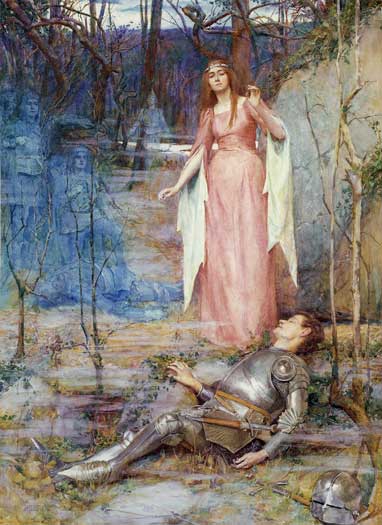
"La Belle Dame sans Merci" (French for "The Beautiful Lady Without Mercy") is a ballad written by the English poet John Keats. It exists in two versions, with minor differences between them. The original was written by Keats in 1819. He used the title of the 15th-century La Belle Dame sans Mercy by Alain Chartier, though the plots of the two poems are different.
The poem is considered an English classic, stereotypical of other of Keats' works. It avoids simplicity of interpretation despite simplicity of structure. At only a short twelve stanzas, of only four lines each, with a simple ABCB rhyme scheme, the poem is nonetheless full of enigmas, and has been the subject of numerous interpretations.
In poetry, a stanza is a grouped set of lines within a poem, usually set off from other stanzas by a blank line or indentation. Stanzas can have regular rhyme and metrical schemes, though stanzas are not strictly required to have either. There are many unique forms of stanzas. Some stanzaic forms are simple, such as four-line quatrains. Other forms are more complex, such as the Spenserian stanza. Fixed verse poems, such as sestinas, can be defined by the number and form of their stanzas. The term stanza is similar tostrophe, though strophe is sometimes used to refer to irregular set of lines, as opposed to regular, rhymed stanzas.
somewhere i have never travelled,gladly beyond
somewhere i have never travelled,gladly beyond
any experience,your eyes have their silence:
in your most frail gesture are things which enclose me,
or which i cannot touch because they are too near

your slightest look easily will unclose me
though i have closed myself as fingers,
you open always petal by petal myself as Spring opens
(touching skilfully,mysteriously)her first rose

or if your wish be to close me,i and
my life will shut very beautifully,suddenly,
as when the heart of this flower imagines
the snow carefully everywhere descending;

nothing which we are to perceive in this world equals
the power of your intense fragility:whose texture
compels me with the colour of its countries,
rendering death and forever with each breathing

(i do not know what it is about you that closes
and opens;only something in me understands
the voice of your eyes is deeper than all roses)
nobody,not even the rain,has such small hands
Dionysus is the god of the grape harvest, winemaking and wine, of ritual madness, fertility, theatre and religious ecstasy in Greek mythology. Alcohol, especially wine, played an important role in Greek culture with Dionysus being an important reason for this life style. His name, thought to be a theonym in Linear B tablets as di-wo-nu-so (KHGq 5 inscription), shows that he may have been worshipped as early as c. 1500–1100 BC by Mycenean Greeks; other traces of the Dionysian-type cult have been found in ancient Minoan Crete. His origins are uncertain, and his cults took many forms; some are described by ancient sources as Thracian, others as Greek. In some cults, he arrives from the east, as an Asiatic foreigner; in others, from Ethiopia in the South. He is a god of epiphany, "the god that comes", and his "foreignness" as an arriving outsider-god may be inherent and essential to his cults. He is a major, popular figure of Greek mythology and religion, and is included in some lists of the twelve Olympians. Dionysus was the last god to be accepted into Mt. Olympus. He was the youngest and the only one to have a mortal mother. His festivals were the driving force behind the development of Greek theatre. Modern scholarship categorises him as a dying-and-rising god.
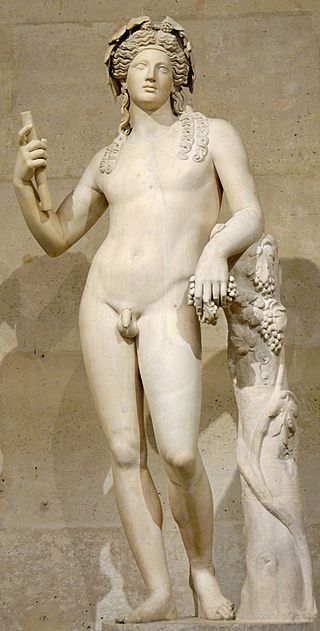
The dithyramb was an ancient Greek hymn sung and danced in honor ofDionysus, the god of wine and fertility; the term was also used as an epithet of the god: Plato, in The Laws, while discussing various kinds of music mentions "the birth of Dionysos, called, I think, the dithyramb." Plato also remarks in the Republicthat dithyrambs are the clearest example of poetry in which the poet is the only speaker.Plutarch contrasted the dithyramb's wild and ecstatic character with the paean. According to Aristotle, the dithyramb was the origin of Athenian tragedy. A wildly enthusiastic speech or piece of writing is still occasionally described as dithyrambic.


沒有留言:
張貼留言