Week three
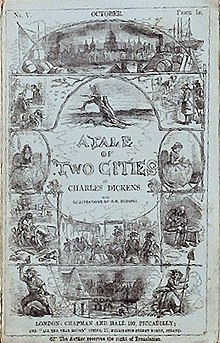
A Tale of Two Cities (1859) is a novel by Charles Dickens, set in London and Paris before and during the French Revolution. The novel depicts the plight of the French peasantry demoralized by the French aristocracy in the years leading up to the revolution, the corresponding brutality demonstrated by the revolutionaries toward the former aristocrats in the early years of the revolution, and many unflattering social parallels with life in London during the same period. It follows the lives of several characters through these events. A Tale of Two Cities was published in weekly installments from April 1859 to November 1859 in Dickens's new literary periodical titled All the Year Round. All but three of Dickens's previous novels had appeared only as monthly installments.
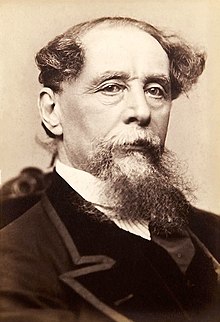
Charles John Huffam Dickens ( February 1812 – 9 June 1870) was an English writer and social critic. He created some of the world's best-known fictional characters and is regarded as the greatest novelist of the Victorian era. His works enjoyed unprecedented popularity during his lifetime, and by the twentieth century critics and scholars had recognised him as a literary genius. His novels and short stories enjoy lasting popularity.
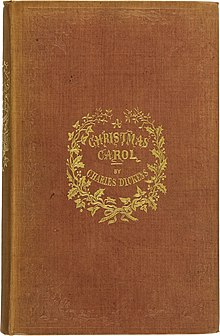
A Christmas Carol in Prose, Being a Ghost-Story of Christmas, commonly known as A Christmas Carol, is a novella byCharles Dickens, first published in London by Chapman & Hall on 19 December 1843. The novella met with instant success and critical acclaim. A Christmas Carol tells the story of a bitter old miser named Ebenezer Scrooge and his transformation into a gentler, kindlier man after visitations by the ghost of his former business partner Jacob Marley and the Ghosts of Christmas Past, Present and Yet to Come.
The Western canon is the body of books and, more broadly, music and art that Western scholars generally accept as the most important and influential in shaping Western culture. As such, it includes work perceived as the greatest works of artistic merit. Such a canon is important to the theory of educational perennialism and the development of high culture. The idea of a Canon has been used to address the question What is Art?; according to this approach, a work is art by comparison to the works in the canon—or conversely, any aesthetic law, to be valid, should not rule out any work included in the canon.

https://www.youtube.com/watch?v=sa2uRSqOuB8
Johann Pachelbel was a German composer, organistand teacher who brought the south German organ tradition to its peak. He composed a large body of sacred and secular music, and his contributions to the development of the chorale prelude and fugue have earned him a place among the most important composers of the middle Baroque era.

Harold Bloom (born July 11, 1930) is an American literary critic and Sterling Professor of Humanities at Yale University. Since the publication of his first book in 1959, Bloom has written more than 20 books of literary criticism, several books discussing religion, and a novel. He has edited hundreds of anthologies concerning numerous literary and philosophical figures for the Chelsea House publishing firm. Bloom's books have been translated into more than 40 languages.

A chapel is a religious place of fellowship, prayer and worship that is attached to a larger, often nonreligious institution or that is considered an extension of a primary religious institution. It may be part of a larger structure or complex, such as a college,hospital, palace, prison, funeral home, church, synagogue or mosque, located on board a military or commercial ship, or it may be an entirely free-standing building, sometimes with its own grounds. Many military installations have chapels for the use of military personnel, normally under the leadership of a military chaplain.

church
church

Shall I compare thee to a summer’s day? (Sonnet 18)
Shall I compare thee to a summer’s day?
Thou art more lovely and more temperate.
Rough winds do shake the darling buds of May,
And summer’s lease hath all too short a date.
Sometime too hot the eye of heaven shines,
And often is his gold complexion dimmed;
And every fair from fair sometime declines,
By chance, or nature’s changing course, untrimmed;
But thy eternal summer shall not fade,
Nor lose possession of that fair thou ow’st,
Nor shall death brag thou wand’rest in his shade,
When in eternal lines to Time thou grow’st.
     So long as men can breathe, or eyes can see,
     So long lives this, and this gives life to thee.

沒有留言:
張貼留言